 Hokkaido Tours
Best Time to Visit Hokkaido: Month by Month
The best time to visit Hokkaido depends on which Hokkaido you are chasing: mid-July for Farm Tomita's lavender at its peak, late September for the earliest autumn colour in Japan, or early February for snow and a citywide festival. The flower tours out of Sapporo need a narrow window measured in weeks, while the volcano and city routes run every month of the year regardless of season. This guide works month by month through what is actually blooming, turning or buried in snow, with the real temperatures and snowfall figures behind each verdict, so you can match your dates to the version of Hokkaido you actually came to see.
Quick answer
Mid-July is the best time to visit Hokkaido if flowers are the reason for the trip, though the island rewards different months for different goals: late September for the earliest autumn colour in Japan, and early February for snow and a citywide festival. April, May and November are the thin stretch worth planning around rather than into. Every window below is matched to the Hokkaido day tours we compare, so you can see which routes actually run on your dates.
Key takeaways
- Best single window: Farm Tomita's lavender peaks 12 to 22 July, inside a season that runs 20 June to 10 August
- Runner-up: late September into October, when Daisetsuzan turns mid-September, the earliest autumn colour anywhere in Japan
- Thin months: April, May and November, when several seasonal routes have no departures at all and the winter packing list
- Counterintuitive fact: Sapporo averages 4.79 metres of snow a year, with 137 centimetres falling in January alone
- Best time of day in summer: before about 10:30, ahead of the coach rush at Shirogane Blue Pond
- Book early for festival week: the 77th Sapporo Snow Festival runs 4 to 11 February 2027, and seat and hotel prices climb around it
Seasons at a Glance
How to read the Verdict column
The four seasons split into a green half and a snow half, with April, May and November as the awkward hinges between them. Read the Verdict column first: it is the short answer for whether that stretch is a reason to visit or a reason to wait.
| Season | Temps | What's Out | Crowds | Verdict |
|---|---|---|---|---|
| Spring (April to May) | 4.5°C to 17.9°C average high | Snow melting, no flowers yet; cherry blossom late April into May | Low | Quiet, but thin |
| Summer (June to August) | 21.8°C to 26.4°C average high | Lavender peak 12 to 22 July; Shikisai-no-Oka in colour through September | High, peaking mid-July | Best overall for flowers |
| Autumn (September to October) | 16.4°C to 22.8°C average high | Daisetsuzan turns mid-September; Biei and Furano turn through October | Moderate | Good value, best light |
| Winter (December to March) | −0.4°C to 4.5°C average high | Snow Festival, ski season, Asahiyama Zoo's penguin walk | Moderate, peaking festival week | Best for snow |
What the numbers say
August is the warmest month on the table at 26.4 degrees Celsius average daily high; January is the coldest at minus 0.4 degrees. Figures are Japan Meteorological Agency normals for Sapporo, so treat every number as typical rather than a forecast, and check conditions closer to your travel dates.
Spring (April to May): Melting Snow, Late Blossom
Cold, quiet and six weeks behind Tokyo
Average daily highs climb from 11.7 degrees Celsius in April to 17.9 in May, but the calendar does not move as fast as the thermometer suggests. Sapporo's cherry blossom does not open until around 27 April and peaks roughly 1 to 6 May, six weeks after Tokyo's, at Maruyama Park and the grounds of Hokkaido Shrine. Asahiyama Zoo closes outright for its spring changeover, 8 to 28 April, so this is a genuinely awkward window for anyone building a trip around the zoo or the flower farms, both of which are still weeks from opening.
- Daytime highs: 11.7°C (April) to 17.9°C (May)
- Crowds: low, aside from the short cherry-blossom peak
- Price signal: cheapest hotel rates of the warm half of the year
- What still runs: the Noboribetsu and Lake Toya circuit, unaffected because the volcanic steam has no season
Summer (June to August): Peak Flowers, Peak Crowds
The window nearly everyone is aiming for
Farm Tomita's 2026 season runs 20 June to 10 August, with peak bloom roughly 12 to 22 July; the farm publishes a daily lavender forecast so you can check the exact state of the fields before you commit to a date. Shikisai-no-Oka is more forgiving, rotating colour bands from June through September, which is why it still photographs well after the lavender at Farm Tomita has been cut. Average highs run from 21.8 degrees in June to 26.4 in August, and this is also when the Cape Kamui gate keeps its widest hours, open as late as 18:30 in June.
- Daytime highs: 21.8°C (June) to 26.4°C (August)
- Crowds: high, peaking around the 12 to 22 July lavender window
- Price signal: peak-season rates on hotels and tours alike
- Best flower tours: the Biei and Furano van or the seasonal coach's lavender route, both timed to the flower calendar
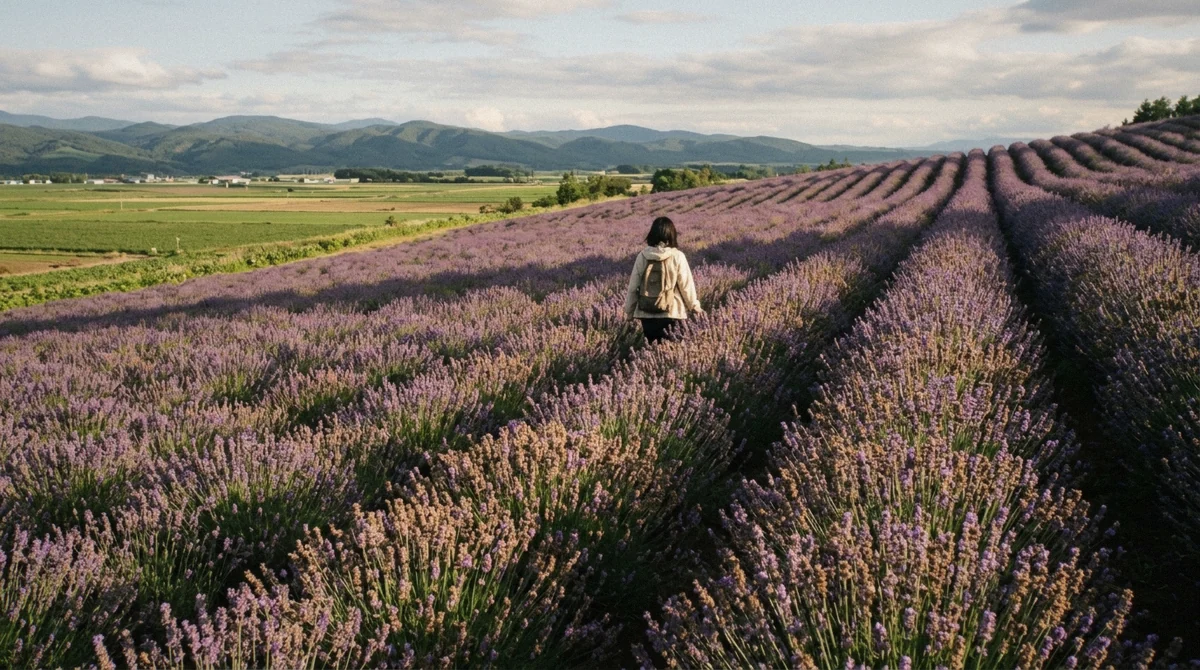
Furano in mid-July, the height of the 2026 lavender season, which ran 20 June to 10 August.
Autumn (September to October): Earliest Colour in Japan
Cooler, quieter, and first to turn
Daisetsuzan turns mid-September, the earliest autumn colour anywhere in Japan, three to four weeks ahead of Kyoto. Biei and Furano follow through October as the colour moves down from the mountains onto the farmland. Average highs drop from 22.8 degrees in September to 16.4 in October, cool enough for a jacket by evening but still comfortable for a full day outdoors, and hotel rates and tour crowds both ease off from the July peak.
- Daytime highs: 16.4°C (October) to 22.8°C (September)
- Crowds: moderate, thinning through October
- Price signal: softer than July and August, before the winter festival premium returns
- Colour-season route: the Furano and Biei coach's autumn itinerary, coded to run through the turning colour
Winter (December to March): Snow, Festival, Short Days
The other half of Hokkaido entirely
Winter is when the island turns into a different destination. December through March brings average highs from 4.5 degrees down to minus 0.4, with January the coldest and snowiest month on the calendar. The 77th Sapporo Snow Festival runs 4 to 11 February 2027 across three sites, Odori Park, Susukino and Tsudome, and hotel and tour seats around that week are the first to sell out all year.
This is also the one season that closes a whole route on this page: the Cape Kamui gate opens only 10:00 to 15:00 from December to March and shuts outright in bad weather, which is why the coast tours are built as summer products rather than year-round ones.
- Daytime highs: −0.4°C (January) to 4.5°C (March)
- Crowds: moderate overall, spiking hard around festival week
- Price signal: a festival-week premium on hotels; otherwise the quietest booking window of the year
- Winter-only routes: ski day at Asarigawa or the seasonal coach's winter itinerary through greenhouse lavender
What Actually Decides Your Date
Twelve months of highs and snowfall
The two numbers that matter most for planning a Hokkaido trip are the average daily high and how much snow is on the ground. Figures are Japan Meteorological Agency normals for Sapporo; treat them as typical, not a forecast, and check closer to your dates.
| Month | Average High | Snowfall |
|---|---|---|
| January | −0.4°C | 137 cm |
| February | 0.4°C | 116 cm |
| March | 4.5°C | 74 cm |
| April | 11.7°C | 6 cm |
| May | 17.9°C | 0 cm |
| June | 21.8°C | 0 cm |
| July | 25.4°C | 0 cm |
| August | 26.4°C | 0 cm |
| September | 22.8°C | 0 cm |
| October | 16.4°C | 1 cm |
| November | 8.7°C | 30 cm |
| December | 2.0°C | 113 cm |
The 4.79-metre year
Sapporo takes 4.79 metres of snow in an average year, and nearly all of it falls across four months: January, February, November and December. June through September gets essentially none, which is exactly the window when the flower tours and the coast tours run, and exactly why this page splits so cleanly into a summer half and a winter half.
Best Season by Traveller Type
If Photographer chasing the lavender fields
The second and third week of July, when Farm Tomita is at its 12 to 22 July peak and Shikisai-no-Oka's bands are also in full colour
If Family with young children
Late September, with mild daytime highs near 22.8°C, thinner crowds than August, and Asahiyama Zoo back on its full summer hours
If Budget traveller
Late September into October, cooler than August but noticeably cheaper on hotels and easier to book
If Snow and festival traveller
The first half of February, timed to the Sapporo Snow Festival's 4 to 11 February 2027 dates, booked well ahead of the week itself
If First-timer wanting the easiest logistics
June, before the mid-July lavender crush and before the 8 to 16 August Obon-week gridlock, with every seasonal route already running
Best Time of Day
Morning, before the coaches
On any summer day, the best hours at the northern sights are the first ones. The Biei van leaves Sapporo with hotel pickup running 07:30 to 08:00 and reaches Shirogane Blue Pond around 10:30, ahead of the larger coaches that tend to arrive later in the morning; the pond's cobalt water photographs best in that earlier light, before midday sun flattens it and the boardwalk fills. The same logic holds at Farm Tomita and Shikisai-no-Oka: an early departure buys quieter paths and softer light, while an afternoon arrival trades both for a busier, flatter-looking field.
Crowds, Prices and the Dates to Avoid
The weeks to plan around, not into
Two windows are worth naming outright. The week of 8 to 16 August 2026 sits inside Japan's Obon holiday, and operators running the northern routes tell travellers plainly not to book flights, trains or evening dinner reservations on a tour day that week, since road traffic can eat into the schedule. The Sapporo Snow Festival week, 4 to 11 February 2027, is the winter equivalent: hotel rooms and winter tour seats around Odori Park, Susukino and Tsudome sell out first and command the year's highest rates.
Outside those two weeks, prices track the season more than any single date, cheapest in the spring and autumn shoulders and highest through the July lavender peak. The full price comparison across all nine tours breaks down exactly where that seasonal premium shows up.
So, When Should You Go?
The verdict
If lavender is the reason for the trip, book the second or third week of July and accept the crowds that come with the peak. If you would rather have quieter paths, better light and a lower hotel bill, late September into October delivers Daisetsuzan's early colour and a calmer version of the same landscapes. Winter is a genuinely different, worthwhile trip on its own terms, built around the early-February festival window rather than against it.
April, May and November are the months to plan around rather than into, when the flowers are not up, the snow is going or gone, and several seasonal routes simply are not running. For the full lineup of Hokkaido tours from Sapporo across every one of these windows, the comparison page breaks down price, hours and what each route actually covers.
Questions About the Best Time to Visit Hokkaido
What is the best month to visit Hokkaido for flowers?
July, and specifically 12 to 22 July, when Farm Tomita's lavender is at its documented peak inside a season that runs 20 June to 10 August. Shikisai-no-Oka stays in colour longer, through September, for anyone visiting outside that narrow window.
When is cherry blossom season in Hokkaido?
Blossom opens around 27 April and peaks roughly 1 to 6 May in Sapporo, about six weeks behind Tokyo's season. Maruyama Park and the grounds of Hokkaido Shrine are the city's main viewing spots.
Is Hokkaido good to visit in winter?
Yes, for a genuinely different trip. The Sapporo Snow Festival runs 4 to 11 February 2027 across three sites, ski season is in full swing, and Asahiyama Zoo's penguin walk happens only in its winter session. The trade-off is short daylight and average highs below freezing from December through March.
How much snow does Hokkaido get?
Sapporo averages 4.79 metres of snow a year. January is the heaviest single month at 137 centimetres, followed by December at 113 and February at 116, with almost none falling from May through September.
When is the Sapporo Snow Festival?
The 77th edition runs 4 to 11 February 2027, spread across Odori Park, Susukino and Tsudome. Hotel rooms and winter tour seats around that week sell out earliest of the whole year.
Which months should I avoid in Hokkaido?
April, May and November are the thin stretch: the snow is melting or just arriving, the flowers are not up, and Asahiyama Zoo closes outright for changeover from 8 to 28 April and again 4 to 10 November. The volcano and city routes still run through all three months if your dates are fixed.
Can you see the Otaru Blue Cave any time of year?
Cruises sail seasonally along the Shakotan coast, but entry into the cave itself has been suspended since a 2025 rockfall and boats now sail to the mouth only, whatever the season. Full status on the Blue Cave.